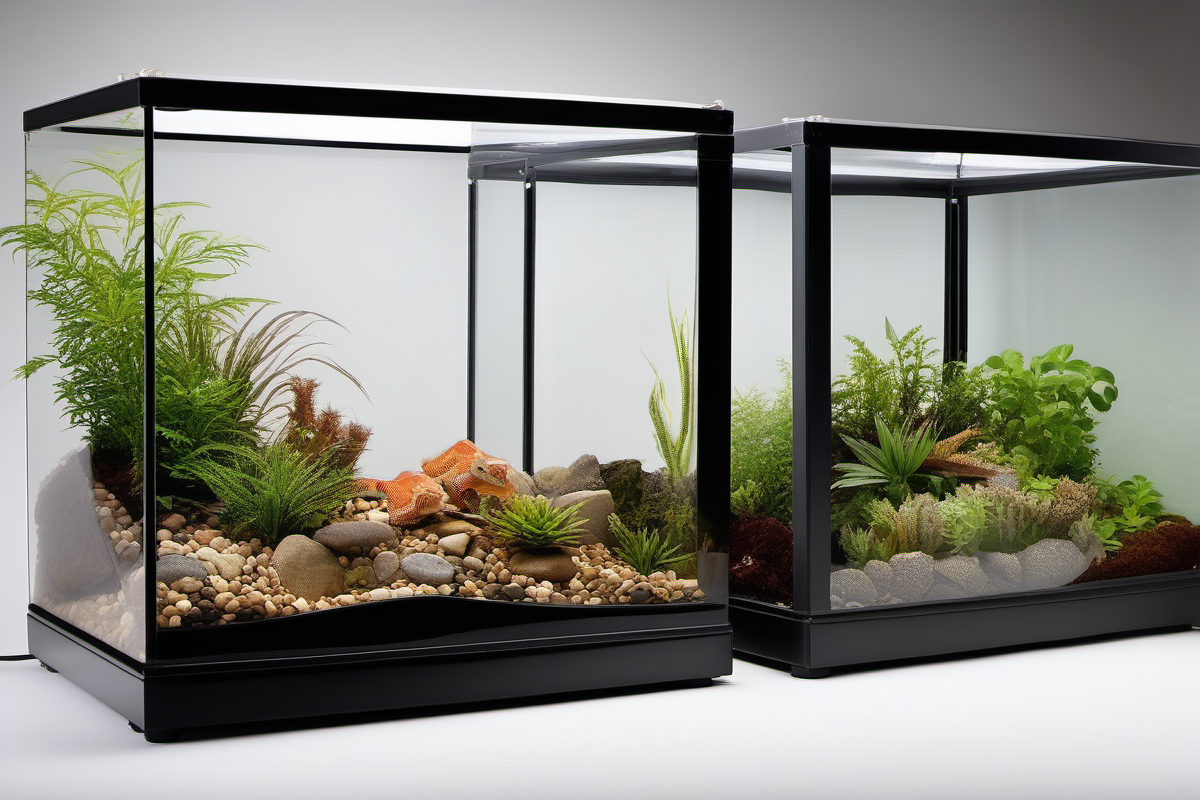
The enclosure is the foundation of your bearded dragon’s health — and the biggest single purchase you’ll make. Get this right and everything else (heating, UVB, substrate) is much easier. Get it wrong, and you’ll fight temperature problems for years.
This guide covers the best bearded dragon tanks and enclosures for every budget, plus what to look for before you buy.
Our Top Picks at a Glance
| Pick | Product | Best for |
|---|---|---|
| Best overall | Zen Habitats 4x2x2 PVC enclosure | Adult dragons, long-term setup |
| Best budget PVC | Dubia.com 4x2x2 enclosure | Adults on a budget |
| Best glass | Exo Terra / Zoo Med glass terrarium | Juveniles and display setups |
| Best starter | 40-gallon breeder tank | Babies and temporary housing |
What Size Tank Do You Really Need?
An adult bearded dragon needs a minimum of 4 x 2 x 2 ft (about 120 gallons). Smaller tanks can work temporarily for babies and juveniles, but you’ll upgrade within a year — so buying the adult size first is cheaper in the long run.
Why 4x2x2 matters: it’s the smallest footprint that reliably holds a proper temperature gradient (a hot end and a cool end). In a tank that’s too small, the whole thing becomes one temperature, and your dragon can’t digest properly.
Best Overall: Zen Habitats 4x2x2 PVC Enclosure
- Material: PVC panels (holds heat well, lightweight)
- Size: 4x2x2 ft — the adult standard
- Doors: sliding front glass doors
- Why we like it: easy to assemble, excellent heat retention, built for reptiles (not a repurposed aquarium). The most popular “forever” enclosure in the community.
Best Budget PVC: Dubia.com 4x2x2 Enclosure
- Material: PVC/ABS panels
- Size: 4x2x2 ft
- Why we like it: similar design to premium PVC enclosures at a noticeably lower price. A favorite for keepers setting up multiple dragons.
Best Glass: Exo Terra / Zoo Med Glass Terrarium
- Material: glass with front-opening doors
- Best size for juveniles: 36–40 gallons
- Why we like it: looks great, widely available, easy to clean. Downside: glass loses heat faster than PVC, so it’s better in warmer rooms.
What to Look for in a Bearded Dragon Tank
- Size: 4x2x2 ft for adults; at least 40 gallons for a baby.
- Material: PVC holds heat best; glass is fine in warm homes; wood insulates well but needs sealing.
- Front-opening doors: top-opening aquariums make it hard to reach in without scaring your dragon (overhead movement looks like a predator).
- Ventilation: enough airflow to prevent humidity buildup (ideal 30–40%).
- Secure lid/screen: dragons climb, and a secure top keeps heat lamps safe and your dragon inside.
Avoid These Mistakes
- Buying a 20-gallon “kit” as a permanent home — too small for an adult.
- Top-opening fish aquariums — harder to maintain proper heat and to reach your dragon.
- Buying twice: starting too small and upgrading means paying for two enclosures.
Affiliate disclosure: this page contains product recommendations. If you buy through links on our site, we may earn a commission at no extra cost to you. This does not affect our recommendations — we only suggest products that are widely used and well-reviewed in the bearded dragon community.
Disclaimer: This guide is for general education and does not replace professional veterinary advice.
Further Reading
Short answer: The best bearded dragon tank is a 120-gallon (48″ × 24″ × 24″) front-opening glass terrarium from a specialist brand like Zen Habitats, Reptizoo, or Carolina Custom Cages. Minimum adult size is 75 gallons (36″ × 18″ × 18″); baby dragons can start in a 40-gallon breeder but should upgrade within 6 months. Avoid all-glass top-opening aquariums — they stress dragons and trap humidity.
Best Bearded Dragon Tanks & Enclosures — 2026 Quick Comparison
| Tank / Enclosure | Type | Size (gal) | Best For | Price (USD) |
|---|---|---|---|---|
| Zen Habitats Reptile Enclosure | Front-opening PVC | 120 gal (48×24×24″) | Adult dragons (best overall) | $329–$429 |
| Carolina Custom Cages Tall | Front-opening glass | 120 gal (48×24×24″) | Adult dragons (premium) | $549–$649 |
| Reptizoo 67-Gallon | Front-opening glass | 67 gal (36×18×24″) | Juvenile / sub-adult | $189–$249 |
| Dubia.com 120-Gallon | Front-opening PVC | 120 gal (48×24×24″) | Adult dragons (budget PVC) | $269–$329 |
| Exo Terra 40-Gallon Breeder | Top-opening glass | 40 gal (36×18×16″) | Babies only (≤6 months) | $99–$149 |
| DIY PVC (4′ × 2′ × 2′) | Custom build | ~120 gal | Handy owners (best value) | $150–$250 materials |
Always pair your tank with a proper thermostat and UVB + heat lamp setup — a great tank without proper heating still produces a sick dragon.
Bearded Dragon Tank FAQ — 2026 Update
What size tank does an adult bearded dragon need?
An adult bearded dragon needs a minimum 75-gallon tank, but the recommended size is 120 gallons (48″ × 24″ × 24″). Floor space matters more than height — bearded dragons are semi-arboreal but spend most of their time on the ground. A 4-foot-long enclosure gives your dragon enough room to thermoregulate (move between the warm basking zone and cool side) and reduces glass-surfing stress. Smaller than 75 gallons leads to chronic stress and metabolic bone disease.
Can a baby bearded dragon live in a 120-gallon tank?
Yes, but with caveats. A baby can go straight into a 120-gallon tank if you provide extra hiding spots and dense foliage on the cool side — babies feel exposed in large open spaces and may stop eating. Many keepers prefer to start babies in a 40-gallon breeder for the first 3–6 months and upgrade at 12–16 inches long. Either approach works; just don’t keep a baby in anything smaller than 20 gallons or the temperature gradient will collapse.
Front-opening vs top-opening tank — which is better?
Front-opening tanks are strongly preferred for bearded dragons. Top-opening aquariums trigger a predator-avoidance response (bearded dragons are preyed on by birds in the wild), causing chronic stress, reduced appetite, and defensive behaviors. Front-opening enclosures also let you reach the cool side without disturbing the basking zone. Modern specialist brands (Zen Habitats, Carolina Custom Cages, Dubia.com, Reptizoo) all sell front-opening designs specifically for this reason.
Is PVC or glass better for a bearded dragon enclosure?
Both work, with trade-offs:
- Glass: heavier, more scratch-resistant, holds heat slightly less well, shows condensation if humidity spikes, premium look. Cheaper for the size (Reptizoo 67-gal ~$200).
- PVC: lighter, retains heat better, no condensation, easier to drill for cable pass-throughs, slightly more expensive (Zen Habitats 120-gal ~$400). Better insulation for cold rooms.
For most keepers, PVC is the better long-term choice if budget allows — the heat retention alone cuts UVB lamp electricity costs in half over the tank’s life. Glass is fine if your room stays 70–80 °F year-round.
What is the best substrate for a bearded dragon tank?
The best substrate depends on age:
- Babies (<6 months): solid substrate only — non-adhesive shelf liner, tile, or paper towels. Loose substrates cause impaction in juveniles.
- Adults (>12 months): Jurassic Reptile Substrate, Zen Mat, or bioactive substrate mixes work well. If using play sand or bioactive, feed your dragon on a plate or bowl to avoid accidental ingestion.
Avoid: calci-sand, walnut shell, gravel, wood chips, reptile bark. These cause fatal impaction if swallowed and are still widely sold by pet stores despite being inappropriate for bearded dragons.
How much does a complete bearded dragon tank setup cost?
A complete setup typically costs $500–$900 for a new adult bearded dragon, broken down as:
- Tank (75–120 gal): $200–$550
- Heat lamp + dimming thermostat: $30–$80
- UVB light (T5 HO 10.0 or Arcadia 12%): $50–$90
- Basking bulb + fixtures: $25–$60
- Substrate + décor: $80–$150
- Thermometers/hygrometers (×2): $20–$40
Buying the complete bundle from one seller (Dubia.com, Zen Habitats) usually saves $100–$200 vs piecing together. Many keepers reuse the heat lamp and thermostat when upgrading tank sizes.
Can I use a fish aquarium as a bearded dragon tank?
Technically you can, but fish aquariums are not recommended for three reasons:
- Top-opening only — triggers stress (see front-opening answer above).
- Not tall enough — a 75-gal aquarium is only 18″ tall, leaving no room for a deep substrate or proper basking lamp clearance.
- Silicone seams — aquarium-grade silicone can off-gas VOCs harmful to reptiles; reptile-grade silicone is required.
If you must use an aquarium, choose a 40-gallon breeder (36″ × 18″ × 16″) or larger, and add a front-opening conversion kit (Zen Habitats makes one for Exo Terra and standard 36″ tanks). For the same money, a purpose-built reptile enclosure is always better.